What causes defects in thermoformed products is rarely one isolated mistake. Defects usually emerge when material, temperature, tooling, vacuum, and cooling drift out of balance. A thin corner may show excessive stretching. A clear tray may reveal bubbles, stress whitening, or uneven wall thickness. Warpage can appear hours after demolding, when internal stresses finally relax.
The scale of production makes control essential. PlasticsEurope’s Plastics—The Fast Facts 2024 reports global plastics production reached 413.8 million tonnes in 2023. Even a small process variation can therefore create substantial scrap across high-volume thermoforming lines. SPE Thermoforming Division guidance repeatedly emphasizes sheet temperature uniformity, plug-assist timing, mold design, and vacuum performance. These controls are practical, not theoretical. A cold sheet corner, blocked vent, or worn sealing gasket can leave visible evidence within minutes.
James L. Throne, a leading thermoforming researcher and author of Technology of Thermoforming, described the process as “deceptively simple.” That warning remains useful. Operators may blame the mold too quickly. Material moisture, uneven heating, poor trimming, and cooling imbalance can produce similar symptoms. The diagnosis is not always clean. A defect map, infrared temperature readings, thickness measurements, and disciplined trial records provide stronger evidence than visual guesses alone. This article examines what causes defects in thermoformed products, using manufacturing experience, technical guidance, and published industry data. Some explanations may seem incomplete because real production rarely follows textbook conditions. That imperfection matters. Reliable improvement begins by questioning assumptions, not hiding them.
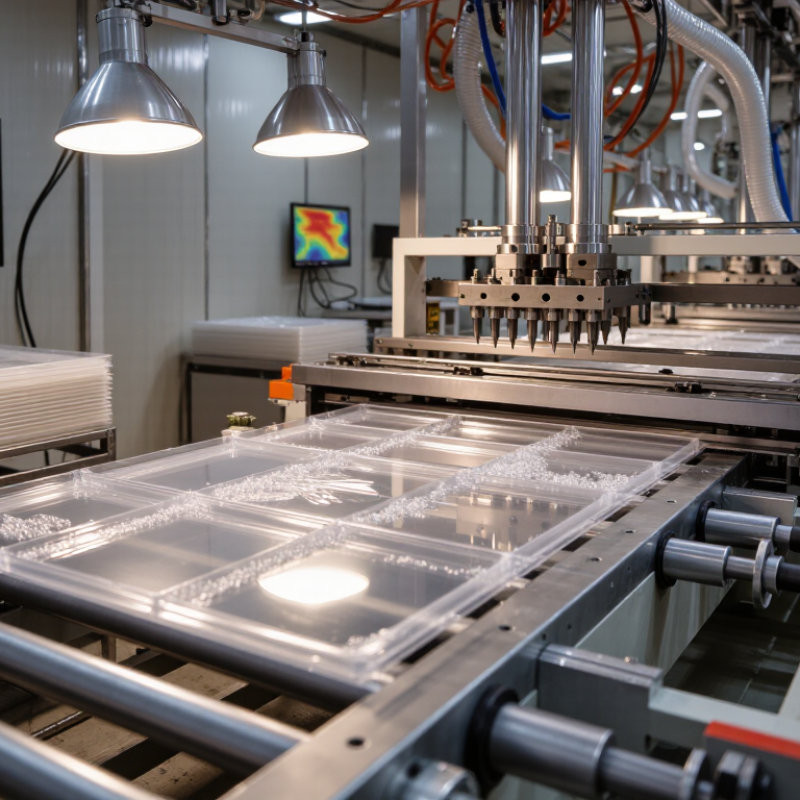
Thermoformed PETG defects often begin before the sheet reaches the forming station. Moisture is a frequent cause, especially when pellets or regrind absorb humidity during storage. For stable processing, PETG moisture should remain below 0.04% before melting. Even a small increase can create bubbles, silver streaks, surface haze, or weak areas after forming.
Drying conditions need practical control. Operators should verify dryer temperature, residence time, airflow, and dew point instead of trusting a timer alone. A sealed hopper helps prevent dried material from absorbing moisture again. Moisture testing can confirm the result, while visual inspection may reveal only the worst cases.
Drying is not optional.
Contamination creates a different defect pattern. Dust, degraded resin, paper fibers, and unmixed color particles can produce black specks, pinholes, rough surfaces, or inconsistent thickness. Regrind should be screened and stored in clean, closed containers. Melt filters and regular barrel cleaning also reduce carryover from previous production.
A small mistake multiplies.
It is easy to blame the mold when the real problem began in material handling. However, drying below 0.04% does not guarantee perfect parts. Excessive heat, long residence time, poor venting, or uneven sheet heating can still damage PETG.
Process records should connect moisture readings with actual defects, not assumptions. That step is often missed, and the missed evidence makes troubleshooting slower.
PETG moisture should stay below 0.04% before melting. Drying is mandatory. Higher moisture may cause bubbles, silver streaks, haze, or weak areas.
Operators should verify temperature, residence time, airflow, and dew point. A timer alone may hide poor drying conditions. Moisture testing provides stronger evidence.
Dried material can absorb humidity from surrounding air. A sealed hopper helps protect it. Open containers can quietly undo the drying process.
Dust, degraded resin, paper fibers, and unmixed color particles may create black specks or pinholes. They can also cause rough surfaces and uneven thickness.
Screen regrind and store it in clean, closed containers. Use melt filters and clean the barrel regularly. Small handling errors can multiply.
No. Excessive heat, long residence time, poor venting, or uneven heating can still create defects. Our assumptions may be wrong.
PP commonly shrinks 1%–2%. Shrinkage may vary across the same part. A 1% change can shift a 500-millimeter panel by about 5 millimeters.
Measure parts after they reach room temperature. Record several locations, including corners and flange areas. One edge is not enough.
Thick corners cool more slowly than thin walls. Uneven mold temperatures, limited airflow, or early demolding may trap stress. Hot parts can flex during clamping.
Support the flange during trimming and use consistent cooling time. Check wall thickness near corners. Compare mold temperature maps with the trimming sequence. Record every change. Memory is unreliable.
Understanding what causes defects in thermoformed products requires examining the entire forming process, from material preparation to final trimming. Moisture and contamination in the sheet can create bubbles, surface marks, or weak areas; for PETG, processing moisture should remain below 0.04%. Uneven heating is another major concern, so sheet temperature variation should be maintained within ±5°C to ensure consistent stretching and forming.
Forming conditions also affect product quality. Industrial vacuum forming typically operates at 0.8–0.95 bar, while improper plug-assist control can lead to uneven material distribution. Tool geometry is equally important because sharp corners may reduce wall thickness by more than 50%, increasing the risk of failure. Finally, cooling and trimming must be carefully managed, since PP products commonly experience 1%–2% shrinkage. Controlling each factor helps improve dimensional accuracy, wall uniformity, appearance, and overall product reliability.

 Switara Packing