Thermoforming can look straightforward: heat a plastic sheet, form it over a tool, then cool and trim it. On the production floor, small changes matter. A few degrees of temperature, uneven clamping, or a worn plug can leave thin corners, warped parts, and scrap bins filling too quickly. So, what are the common challenges in thermoforming operations? The answer usually involves linked process variables, not one isolated fault.
The OECD’s Global Plastics Outlook reports that global plastic waste reached 353 million tonnes in 2019, while only 9% was ultimately recycled. This broad plastics figure is not a thermoforming-specific benchmark. Still, it highlights why material efficiency and scrap control deserve attention. Plastics Europe’s Plastics—The Fast Facts 2024 estimates global plastics production at 413.8 million tonnes in 2023. These reports provide useful industry context, but they do not replace plant-level measurements.
In practice, operators must balance sheet temperature, forming pressure, cooling time, material thickness, and tool design. Too much heat can cause sagging; too little can leave corners poorly formed. Trimming adds another source of variation. And recycling regrind is not always simple: changes in material history may affect forming behavior. The imperfect part of process improvement is that a fix for one defect can create another. That deserves honest attention. This guide examines common defects, root causes, and practical ways to improve consistency without treating every machine or material as identical.
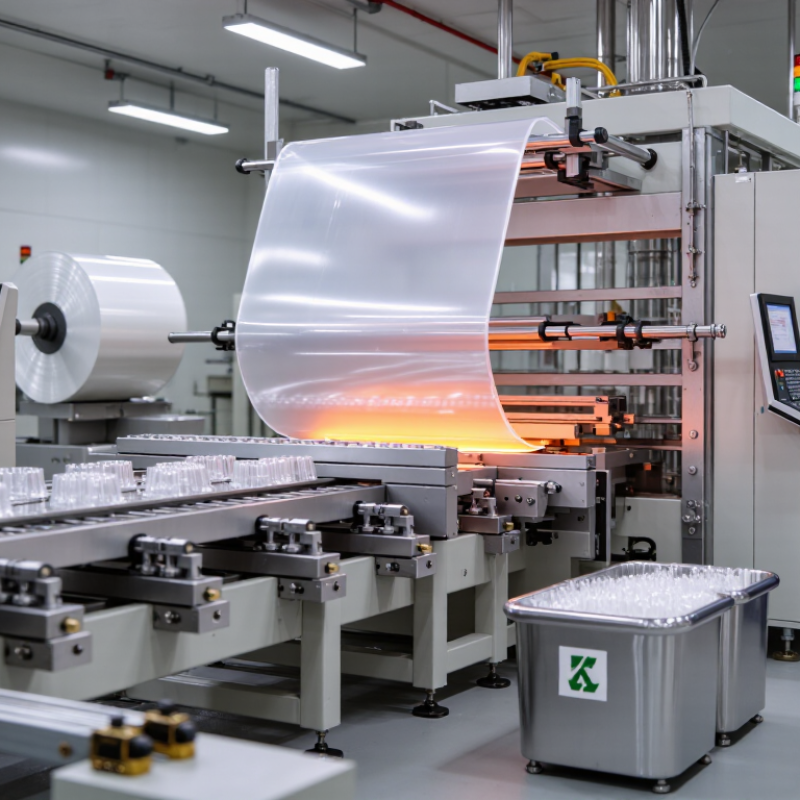
Understanding the Thermoforming Process and Its Key Variables
Thermoforming turns a heated thermoplastic sheet into a part by drawing it over or into a mold. The sequence sounds simple: heat, form, cool, and trim. In practice, each stage affects the next. Sheet temperature controls how evenly material stretches; too cool, and corners may thin or fail to reach the mold. Too hot, and the sheet can sag before forming. Mold temperature, vacuum or pressure, and cooling time also influence detail, wall thickness, and cycle consistency. Not always.
Material type and sheet thickness matter as much as machine settings. A small temperature difference across the sheet can create uneven draw, while poor vent placement may leave soft details. Operators should track actual sheet temperature, not rely only on heater setpoints. A setpoint is a clue, not a measurement. When defects appear, changing several settings at once can hide the cause. It is tempting to blame the mold, but material handling or inconsistent heating may be responsible. Even a stable process needs occasional review; real production rarely behaves perfectly.
Tips: Record sheet lot, thickness, heater zones, forming pressure, and cooling time for each trial. Inspect corners and deep draws first; they can reveal thinning early. Change one variable at a time, then check the part after cooling. Keep it measurable.
Identifying Common Material Heating and Forming Problems
Identifying heating and forming faults starts with the sheet, not the machine settings. PlasticsEurope’s Plastics—The Fast Facts 2024 reports 413.8 million tonnes of global plastics production in 2023, including 35.5 million tonnes of recycled plastics. These figures describe a diverse material supply, not a thermoforming defect rate; resin grade and sheet history still matter. Check the supplier’s forming range before changing oven settings.
Look for a temperature pattern. A glossy, sagging center with stiff edges often points to uneven heating; cold corners may resist the mold and leave thin, stressed areas. Blisters can signal moisture, especially in hygroscopic materials, so verify drying and storage records. Small checks help: map sheet temperature across several zones, confirm heater output, and compare readings with the material specification. Don’t trust one surface reading.
When the sheet heats evenly but details remain soft, inspect vacuum holes, seals, and forming time before raising temperature. Excess heat can thin corners, distort dimensions, or degrade the surface. Recycled content may vary, but the PlasticsEurope production figures cannot predict a particular sheet’s behavior. I would not blame the material too quickly; a blocked vent can look like a heating problem. Record each adjustment, even the imperfect runs.
How to Overcome Common Thermoforming Challenges?
Identifying Common Material Heating and Forming Problems
Approximate sheet-forming temperature ranges vary by grade, thickness, and equipment. Forming below the suitable range can cause poor detail and high stress; overheating can lead to sagging, bubbles, or material degradation. Check the material supplier’s guidance and measure the sheet temperature for your process.
Adjusting Equipment to Prevent Defects and Improve Consistency
Thermoforming consistency depends on coordinated heat, forming pressure, and cooling. A single setting rarely explains every defect. Before adjusting equipment, record the sheet material, thickness, cycle time, and defect location. This creates a useful baseline.
If corners appear thin, check whether the sheet is heating evenly across the platen. Adjust individual heater zones in small steps, then inspect the next formed part. Small changes matter. Avoid simply increasing overall heat; excessive softening can cause sagging or webbing between features. If deep areas fail to form, inspect vacuum lines, seals, and vent holes for leaks or blockage. Confirm that the plug assist meets the sheet at the intended point in the cycle.
Cooling settings also affect repeatability. Parts released too warm may warp, while uneven airflow can distort one side more than the other. Check that cooling channels are clear and that clamps hold the sheet evenly. Change one variable at a time and compare several parts, not just one. In practice, this process is not always tidy: different material batches may respond differently. Note those differences instead of assuming the machine is at fault. A slightly uneven edge can reveal more than a perfect-looking cycle record.
Optimizing Mold Design, Cooling, and Part Release
Thermoforming problems often start at the mold. Sharp corners and uneven wall transitions can concentrate strain, leaving thin spots or webbing between features. Use generous radii, balanced draw depth, and vent paths near areas where trapped air can mark the surface. A small vent adjustment can matter. Still, simulations cannot capture every sheet variation, so confirm design changes with trial runs and thickness checks.
Cooling and release need to be designed together. The U.S. Department of Energy’s 2013 plastics-industry energy report notes that cooling can take up to 80% of an injection-molding cycle. That figure is not thermoforming data, but it underlines why temperature control deserves measurement. In thermoforming, uneven mold temperatures can cause warping, while premature release may distort a warm part. Map surface temperatures across the tool, then adjust cooling channels or dwell time based on actual parts—not guesswork. Draft angles and polished release surfaces can reduce sticking, though excessive draft may compromise fit. This trade-off is easy to underestimate.
Tips: Check wall thickness at corners, ribs, and deep draws. Record release temperature and cycle time for each trial. If parts still drag, inspect vents and surface finish before adding more force. Some fixes will need another iteration. That is normal.
Establishing Quality Checks and Preventive Maintenance
Thermoforming quality depends on repeatable heat, forming pressure, and cooling. A small drift in heater output can leave thin corners, cloudy surfaces, or uneven trim. Record sheet temperature, cycle time, vacuum level, and critical part dimensions at startup and during production. Check thermocouples against a calibrated reference, and inspect vacuum hoses for cracks or loose fittings. Small checks matter.
The U.S. Department of Energy’s Operations & Maintenance Best Practices guide estimates predictive maintenance can save 8–12% compared with preventive maintenance and 30–40% compared with reactive maintenance. These are broad industrial benchmarks, not guaranteed thermoforming results. Still, they support tracking equipment condition before a heater, pump, or cooling circuit fails. A checklist can become theater, though. Review whether each check catches a real defect, and revise it when process conditions change.
Tips: Keep a simple log beside the machine. Note heater-zone readings, vacuum response, and thickness measurements. Flag repeated drift, even when parts still pass. Schedule inspections for heater connections, filters, trim-tool wear, and cooling lines. Assign an owner and a due date. Keep it visible. Recheck settings after tool changes; teams sometimes miss that step.
Conclusion
This article explains how to overcome common thermoforming challenges by examining the process variables that influence reliable production, including material behavior, heating conditions, forming pressure, and cycle timing. It considers what are the common challenges in thermoforming operations, such as uneven heating, incomplete forming, inconsistent wall thickness, wrinkles, and parts that are difficult to release. Understanding how these problems arise helps operators identify the right adjustments rather than relying on guesswork.
The article also describes practical ways to improve consistency: fine-tuning equipment settings, checking that materials are heated evenly, and refining mold design to support proper forming, cooling, and part release. Finally, it highlights the value of routine quality checks and preventive maintenance. Monitoring finished parts and maintaining equipment can help catch small issues early, reduce defects, and keep thermoforming operations dependable over time.

 Switara Packing