Thermoforming may look simple: a heated plastic sheet meets a shaped tool, then cools under controlled pressure. Yet the mold often decides whether the final tray, cup, or panel succeeds. So, what is the role of molds in thermoforming? They define dimensions, surface texture, wall distribution, cooling behavior, and repeatability. A well-designed mold can shorten cycle times and reduce visible defects. A poorly matched tool may create thin corners, webbing, warpage, or difficult release.
This guide introduces China’s top ten thermoforming mold makers and examines the capabilities behind their reputations. The comparison considers engineering experience, aluminum and steel tooling, cooling-channel design, CNC accuracy, prototype support, and inspection practices. It also looks at communication, delivery control, maintenance guidance, and evidence from real manufacturing applications. Small details matter. A polished cavity surface can influence a product’s appearance. A misplaced cooling channel can affect production stability.
No ranking can fit every buyer. That is worth remembering. A packaging producer may need fast, economical aluminum molds, while an automotive supplier may require complex steel tooling and strict dimensional control. Company websites can also present an incomplete picture. Reliable evaluation should include drawings, sample parts, tolerance data, material recommendations, and customer references. The strongest manufacturers do more than cut metal; they help convert a forming concept into a practical, repeatable production process. Some suppliers may still show uneven strengths, and that makes careful comparison necessary.
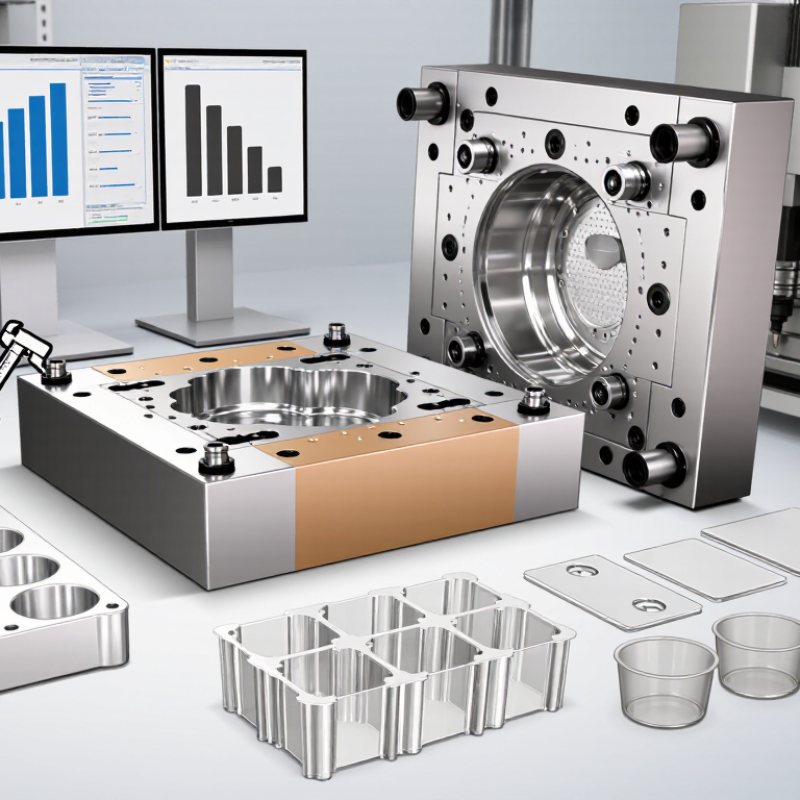
A thermoforming mold is the shaped tool that gives heated plastic sheet its final form. It may be made from aluminum, epoxy, or another suitable material. During production, a plastic sheet softens inside a controlled heating unit. The sheet then moves over the mold. Vacuum pressure, air pressure, or mechanical force pulls it against the mold surface. Small vents help remove trapped air from corners and textured areas. Cooling channels may shorten cycle time and improve dimensional stability. The mold’s draft angles also help operators release the finished part without distortion.
Thermoforming mold makers turn a product drawing into a repeatable production tool. They study wall thickness, shrinkage, trimming allowances, and likely stress points before machining begins. Experienced technicians often test a first sample, measure it, and adjust the mold surface. A sharp edge may look accurate on screen but cause tearing during forming. That detail is easy to underestimate. Surface finish matters too. A polished cavity can create a smooth package, while a textured surface can hide minor marks and improve appearance.
Good tooling requires practical judgment, not only software. Temperature variation, uneven vacuum, and worn seals can change results. The mold may be correct, yet the process still fails. This is where inspection records and controlled trials provide reliable evidence. Some designs need revision after testing. That is normal, and sometimes necessary. A careful maker documents each change, checks repeatability, and confirms the part under realistic production conditions.
Selecting China’s top thermoforming mold makers requires more than a polished catalog. Their role is to turn a formed-part concept into a durable, production-ready tool. Reviewers study practical experience, engineering depth, and repeatable production results. A qualified maker should understand sheet behavior, wall thickness, draft angles, and cooling balance. These details influence trimming accuracy, cycle time, and the final surface. Small details matter.
Selection teams often inspect workshop equipment, machining records, and dimensional reports from recent projects. They may compare trial molds using actual production materials, not only computer drawings. A stable test should show even forming, clean release, and consistent parts across repeated cycles. Measurement tools must be calibrated, and inspection data should remain traceable. Evidence matters. Site visits can also reveal maintenance habits, storage conditions, and communication speed. These observations support more reliable judgments than advertising claims.
Commercial reliability is another filter. Reviewers examine quotation clarity, lead-time control, spare-part support, and response after delivery. A strong technical team explains risks before cutting steel. It should also propose practical changes when a design creates weak corners or uneven cooling. No ranking is perfect. Some evaluations still depend on limited samples, rushed trials, or incomplete customer feedback. That weakness deserves attention, especially when a mold will serve high-volume production. The best selection process remains transparent, documented, and open to revision as new evidence appears.
China’s leading thermoforming mold makers now compete through process control, not only low-cost machining. Their role begins with converting a thin-sheet packaging or automotive design into a stable, repeatable cavity. Grand View Research valued the global thermoforming plastics market at about USD 15.7 billion in 2023. That growth increases pressure on mold suppliers to reduce cycle time, scrap, and maintenance.
Core technology starts with CAD, CAE, and five-axis CNC machining. Engineers simulate sheet stretching before cutting aluminum or steel. Vacuum channels must be positioned carefully, especially around deep corners and narrow ribs. Poor venting leaves webbing, cloudy surfaces, or uneven wall thickness. It happens.
Many advanced Chinese workshops add conformal cooling, temperature sensors, and controlled water circuits. These features help stabilize mold temperature across large surfaces. Laser scanning then compares the finished cavity with its digital model. According to MarketsandMarkets, the thermoforming machines market is projected to grow steadily through 2027, supporting demand for faster and more automated tooling. However, automation does not remove every risk. A precise mold can still produce defects when sheet moisture, heating zones, or clamping pressure are poorly matched. Experienced manufacturers therefore test real materials, record forming temperatures, and inspect trial parts rather than trusting software alone. Reports based on dimensional data, vacuum performance, and cycle results make supplier decisions more reliable.
Thermoforming mold manufacturers select materials and integrate CNC machining, vacuum venting, and temperature-control systems to balance forming accuracy, cycle time, durability, and production cost. Thermal conductivity is a key material property because faster heat transfer can support more consistent cooling and shorter molding cycles.
Thermoforming mold makers turn packaging concepts into repeatable production tools. Their role begins with interpreting drawings, wall thickness targets, draft angles, and material behavior. Experienced teams also question unrealistic details before machining starts. A sharp corner may look attractive on screen, yet it can create thin plastic or difficult release. That conversation protects both quality and tooling cost. Small changes matter.
During design, makers select aluminum, steel, or engineered tooling materials according to temperature, cycle speed, and expected volume. They add vacuum channels, cooling passages, vents, and mounting features that support stable forming. A mold is not merely a cavity. It is part of a controlled process. After machining, technicians inspect dimensions and surface finish with calibrated equipment. Trial runs reveal problems that drawings cannot show, including uneven cooling, webbing, short pulls, or stubborn demolding. Reliable makers record these findings and adjust the tool rather than hiding defects.
They also cooperate with production engineers, operators, and quality teams during sampling and scale-up. Their feedback can reduce scrap, shorten cycle times, and improve part consistency. However, no mold performs perfectly under every condition. Resin batches, ambient temperature, vacuum strength, and machine maintenance can change results. For this reason, responsible makers provide process guidance, inspection data, and practical maintenance instructions. In my experience, the best discussions include failure risks, not only promised output. A useful maker stays involved after delivery, because production often teaches what the workshop missed.
| No. | Production Role | Main Production Stage | Typical Responsibilities | Key Deliverables | Production Value |
|---|---|---|---|---|---|
| 1 | Product Design Support | Concept and design review | Review product geometry for draft angles, wall-thickness requirements, corner radii, undercuts, shrinkage allowance, and thermoforming feasibility. | Design-for-manufacturing feedback and mold feasibility assessment | Reduces redesign, forming defects, and tooling risks before machining. |
| 2 | Mold Engineering | Tooling development | Convert approved product data into mold layouts, component specifications, forming surfaces, mounting features, and serviceable tooling structures. | 2D drawings, 3D models, bills of materials, and engineering change records | Creates a controlled technical basis for manufacturing and inspection. |
| 3 | Material Selection | Tooling specification | Select suitable mold materials and surface treatments according to production volume, forming temperature, abrasion, corrosion exposure, dimensional stability, and maintenance requirements. | Material certificates, treatment requirements, and tooling specifications | Balances tool life, thermal behavior, cost, and maintenance needs. |
| 4 | Thermal and Airflow Planning | Mold construction and process integration | Design vacuum holes, air passages, cooling or heating provisions, venting layouts, and connections between the mold and forming equipment. | Vacuum-channel layouts, cooling arrangements, and interface specifications | Supports uniform sheet forming, accurate detail reproduction, and shorter cycle stabilization. |
| 5 | Precision Machining | Mold manufacturing | Machine mold bases, forming surfaces, inserts, vents, mounting points, and reference features using appropriate cutting and finishing processes. | Machined mold components and process inspection records | Delivers the dimensional accuracy and surface condition required for repeatable forming. |
| 6 | Surface Finishing | Post-machining preparation | Apply polishing, texturing, coating, edge treatment, and cleaning processes according to the required product appearance and release behavior. | Finished forming surfaces and surface-quality inspection results | Influences appearance, demolding performance, cleaning effort, and product consistency. |
| 7 | Assembly and Fit-Up | Tool assembly | Assemble mold sections, inserts, vacuum connections, cooling elements, locating features, and machine-interface components while checking alignment and accessibility. | Assembled mold, fit-up checklist, and interface verification | Ensures reliable installation, alignment, operation, and future servicing. |
| 8 | Inspection and Quality Control | Pre-delivery verification | Check critical dimensions, profile accuracy, surface condition, vacuum continuity, cooling-path integrity, material documentation, and conformity with approved drawings. | Inspection reports, dimensional records, and conformity documentation | Detects defects before the mold reaches production and improves acceptance reliability. |
| 9 | Trial Forming and Process Support | Tool validation and launch | Support trial runs, evaluate wall distribution, detail definition, wrinkles, webbing, vacuum response, demolding, trimming allowance, and cycle behavior. | Trial samples, correction proposals, and process-validation feedback | Shortens commissioning time and helps achieve stable production conditions. |
| 10 | Maintenance and Lifecycle Service | Ongoing production support | Provide cleaning guidance, vent maintenance, repair recommendations, replacement inserts, engineering modifications, and technical support for recurring production issues. | Maintenance instructions, spare-part information, repair records, and modification data | Extends mold service life, protects product quality, and reduces unplanned downtime. |
China’s thermoforming mold makers serve packaging, medical, automotive, and consumer-product manufacturers. Their role extends beyond machining. They translate part drawings into stable forming tools, manage cooling design, and support repeatable production. Fortune Business Insights reports that the global thermoforming market was valued at about USD 15 billion in 2023. Its projected growth increases pressure on suppliers to deliver faster and more consistently.
When evaluating a Chinese mold maker, inspect evidence rather than polished promises. Request material certificates, dimensional inspection reports, mold-flow analysis, and samples from comparable projects. Ask which steel grade is used for the cavity, core, and wear parts. Review cooling-channel layouts carefully. Uneven cooling can create thin corners, warping, or visible stress marks. ISO 9001 certification supports process control, but it does not guarantee mold performance. Confirm calibration records and traceability for critical measurements. A video call inside the workshop can reveal maintenance habits, inspection equipment, and actual production capacity. Price matters, but an unusually low quotation may hide weaker steel or limited testing.
Tips: Define acceptance criteria before requesting quotations. Include cycle time, sheet thickness, surface finish, shrinkage tolerance, and trial-shot requirements. Ask for a written correction policy. Speak with two recent customers, if possible. No checklist is perfect. I would still schedule an independent pre-shipment inspection for high-value tools, especially when communication is mostly remote. Procurement reports from the International Trade Centre also show how cross-border sourcing depends on clear specifications and reliable supplier verification.
It is a shaped tool that gives heated plastic sheet its final form. The mold may use aluminum, epoxy, or another suitable material. Small vents help remove trapped air from corners and textured areas.
A heating unit softens the plastic sheet under controlled conditions. The sheet moves over the mold surface. Vacuum, air pressure, or mechanical force pulls it into shape. Cooling then helps stabilize the finished part.
Draft angles help operators release the formed part without distortion. Without enough draft, edges may stick or tear. The design can look correct but still release poorly.
The maker should review wall thickness, shrinkage, trimming allowances, and stress points. Sharp corners may create thin plastic during forming. A small radius often works better. Small changes matter.
Aluminum, steel, epoxy, and engineered tooling materials may suit different production needs. The choice depends on temperature, cycle speed, durability, and expected volume. The cheapest material is not always the practical choice.
Review recent machining records, dimensional reports, inspection methods, and trial results. Ask whether testing uses actual production materials. A stable trial should show clean release and consistent parts across repeated cycles. Evidence matters.
Trials may expose uneven cooling, webbing, short pulls, tearing, or difficult demolding. Temperature variation and weak vacuum can also change results. The mold may be correct, yet the process can still fail.
A responsible maker should provide inspection data, process guidance, and maintenance instructions. Production teams may need help adjusting vacuum, temperature, seals, or cooling. No mold performs perfectly everywhere. That deserves reflection.
Thermoforming molds are precision tools that shape heated plastic sheets into trays, containers, panels, and other products through controlled vacuum, pressure, or mechanical forming. In exploring what is the role of molds in thermoforming, it is important to recognize that molds determine the product’s dimensions, surface quality, wall distribution, repeatability, and production efficiency. Their design must account for material behavior, cooling, demolding, ventilation, and the intended application.
China’s top thermoforming mold makers are commonly evaluated by engineering capability, machining accuracy, material selection, quality control, delivery performance, and after-sales support. Leading manufacturers use CAD/CAM design, CNC machining, digital inspection, simulation, and optimized cooling and venting systems to produce reliable molds. They also support customers by improving product design, selecting suitable mold structures, reducing forming defects, shortening cycle times, and adapting tooling for different production volumes. A dependable Chinese mold maker should communicate clearly, provide verifiable technical documentation, maintain consistent quality standards, and offer practical solutions throughout design, testing, production, and maintenance.

Switara Packing